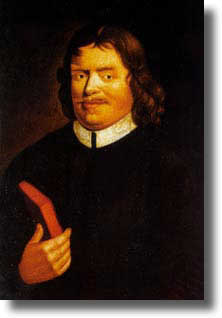
(Bunyan died 31 August 1688, but is remembered a day early, to make room for Aidan.)
John Bunyan was born in 1628 near Bedford (52:08 N 0:29 W), in the agricultural midlands of England . He was the son of a tinker (a maker and mender of metal pots). He had little schooling. During the Parliamentary Army . He underwent a period of acute spiritual anxiety, and finally found peace in a Baptist congregation. He became a lay preacher, while earning his living as a tinker.
After the Restoration in 1660, Bunyan (under suspicion for having fought on the anti-Anglican side) was ordered to preach no more, and, since he refused to desist, he was several times sentenced to jail, where he spent his time studying, preaching to his fellow prisoners, and writing. His first substantial work was an autobiography, Grace Abounding to the Chief of Sinners . This was followed by other works, of which by far the most read and most loved is The Pilgrim's Progress from This World to That Which is to Come, usually called Pilgrim's Progress . The work recounts in allegorical form the experience of a person (called Christian), from his his first awareness of his sinfulness and spiritual need, to his personal conversion to Christ, to his walk as a believer. He is shown as a pilgrim in this world on his way to the "Celestial City," which will be his true home forever.
The work was an immediate sensation, and its popularity endured. For a century and more thereafter, there were many English-speaking Christians who were thoroughly familiar with only two books, The Bible and Pilgrim's Progess. (Those who have read the book or seen the movie Little Women, portraying the life of an American family in the 1860's, will remember that the book was a family favorite.)
Three extracts follow:
The Pilgrim's Progress in the Similitude of a Dream
As I walked through the wilderness of this world, I lighted on a certain place where was a Den, and I laid me down in that place to sleep: and, as I slept, I dreamed a dream. I dreamed, and behold, I saw a man clothed with rags, standing in a certain place, with his face from his own house, a book in his hand, and a great burden upon his back. I looked, and saw him open the book, and read therein; and, as he read, he wept, and trembled; and, not being able longer to contain, he brake out with a lamentable cry, saying, What shall I do?
In this plight, therefore, he went home and refrained himself as long as he could, that his wife and children should not perceive his distress; but he could not be silent long, because that his trouble increased. Wherefore at length he brake his mind to his wife and children; and thus he began to talk to them: O my dear wife, said he, and you the children of my bowels, I, your dear friend, am in my self undone by reason of a burden that lieth hard upon me; moreover, I am for certain informed that this our city will be burned with fire from heaven; in which fearful overthrow, both myself, with thee my wife, and you my sweet babes, shall miserably come to ruin, except (the which yet I see not) some way of escape can be found, whereby we may be delivered. At this his relations were sore amazed; not for that they believed that what he had said to them was true, but because they thought that some frenzy distemper had got into his head; therefore, it drawing towards night, and they hoping that sleep might settle his brains, with all haste they got him to bed. But the night was as troublesome to him as the day; wherefore, instead of sleeping, he spent it in sighs and tears. So, when the morning was come, they would know how he did. He told them, Worse and worse: he also set to talking to them again; but they began to be hardened. They also sought to drive away his distemper by harsh and surly carriages to him; sometimes they would deride, sometimes they would chide, and sometimes they would quite neglect him. Wherefore he began to retire himself to his chamber, to pray for and pity them, and also to condole his own misery; he would also walk solitarily in the fields, sometimes reading, and sometimes praying: and thus for some days he spent his time.
Now, I saw, upon a time, when he was walking in the fields, that he was, as he was wont, reading in his book, and greatly distressed in his mind; and, as he read, he burst out, as he had done before, crying, What shall I do to be saved?
I saw also that he looked this way and that way, as if he would run; yet he stood still, because, as I perceived, he could not tell which way to go. I looked then, and saw a man named Evangelist coming to him, who asked, Wherefore dost thou cry? He answered, Sir, I perceive by the book in my hand, at I am condemned to die, and after that to come to judgment; and I find that I am not willing to do the first, nor able to do the second.
Then said Evangelist, Why not willing to die, since this life is attended with so many evils? The man answered, Because I fear that this burden that is upon my back will sink me lower than the grave, and I shall fall into Tophet. And, Sir, if I be not fit to go to prison, I am not fit, I am sure, to go to judgment, and from thence to execution; and the thoughts of these things make me cry.
Then said Evangelist, If this be thy condition, why standest thou still? He answered, Because I know not whither to go. Then he gave him a parchment roll, and there was written within, Flee from the wrath to come.
Now when he [Christian] was got up to the top of the Hill, there came two men running up against him amain; the name of the one was Timorous, and the name of the other Mistrust. To whom Christian said, "Sirs, what's the matter you run the wrong way?" Timorous answered that they were going to the city of Sion, and had got up that difficult place; "But," said he, "the further we go, the more danger we meet with, wherefore we turned, and are going back again."
"Yes," said Mistrust, 'for just before us lie a couple of lions in the way, whether sleeping or waking we know not and we could not think, if we came within reach, but they would presently pull us in pieces."
Then said Christian, "You make me afraid, but whither shall I fly to be safe? If I go back to mine own country, that is prepared for fire and brimstone, and I shall certainly perish there. If I can get to the Celestial City, I am sure to be in safety there. I must venture: to go back is nothing but death, to go forward is fear of death, and life everlasting beyond it. I will yet go forward." So Mistrust and Timorous ran down the Hill, and Christian went on his way.
Now I saw in my dream, that these two men [Christian and Hopeful] went in at the Gate; and lo, as these entered they were transfigured, and they had raiment put on that shone like gold. There was also that met them, with harps and crowns, and gave them to them, the harp to praise withal, and the crowns in token of honour. Then I heard in my dream, that all the bells in the City rang again for joy; and that it was said unto them, "ENTER YE INTO THE JOY OF YOUR LORD." I also heard the men themselves, that they sang with a loud voice, saying, "BLESSING, HONOUR, GLORY, AND POWER, BE TO HIM THAT SITTETH UPON THE THRONE AND TO THE LAMB FOR EVER AND EVER."
Now just as the Gates were opened to let in the men, I looked in after them; and behold, the City shone like the sun, the streets also were paved with gold, and in them walked many men with crowns on their heads, palms in their hands, and golden harps to sing praises withal.
There were also of them that had wings, and they answered one another without intermission, saying, HOLY, HOLY, HOLY, IS THE LORD. And after that, they shut up the Gates: which when I had seen, I wished myself among them.
written by James Kiefer