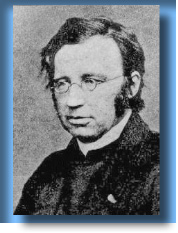
John Mason Neale was born in London in 1818, studied at Cambridge , and was ordained to the priesthood in 1842. He was offered a parish, but chronic ill health, which was to continue throughout his life, prevented him from taking it. In 1846 he was made warden of Sackville College , a position he held for the rest of his life. Sackville College was not an educational institution, but an almshouse, a charitable residence for the poor.
In 1854 Neale co-founded the Sisterhood of St. Margaret , an order of women in the Anglican Church dedicated to nursing the sick. Many Anglicans in his day, however, were very suspicious of anything suggestive of Roman Catholicism . Only nine years earlier, John H. Newman had encouraged Romish practices in the Anglican Church, and had ended up joining the Romanists himself. This encouraged the suspicion that anyone like Neale was an agent of the Vatican , assigned to destroy the Anglican Church by subverting it from within. Once Neale was attacked and mauled at a funeral of one of the Sisters. From time to time unruly crowds threatened to stone him or to burn his house. He received no honor or preferment in England , and his doctorate was bestowed by an American college ( Trinity College, Hartford , Connecticut). However, his basic goodness eventually won the confidence of many who had fiercely opposed him, and the Sisterhood of St. Margaret survived and prospered.
However, he is best known as a hymn writer and translator, having enriched English hymnody with many ancient and mediaeval hymns translated from Latin and Greek, including the hymns listed at right, and many others. More than anyone else, he made English-speaking congregations aware of the centuries-old tradition of Latin, Greek, Russian, and Syrian hymns.
A portion of an article by Neale follows:
Among the most pressing of the inconveniences consequent on the adoption of the vernacular language in the office-books of the Reformation, must be reckoned the immediate disuse of all the hymns of the Western Church. That treasury, into which the saints of every age and country had poured their contributions, delighting, each in his generation, to express their hopes and fears, their joys and sorrows, in language which whould be the heritage of their Holy Mother until the end of time--those noble hymns, which had solaced anghorets on their mountains, monks in their cells, priests in bearing up against the burden and heat of the day, missionaries in girding themslves for martyrdom--henceforth became as a sealed book and as a dead letter. The prayers and collects, the versicles and responses, of the earlier Church might, without any great loss of beauty, be preserved; but the hymns, whether of the sevenfold daily office, of the weekly commemoration of creation and redemption, of the yearly revolution of the Church's seasons, or of the birthdays to glory of martyrs and confessors--those hymns by which day unto day had uttered speech, and night unto night had taught knowledge--could not, by the hands then employed in ecclesiastical matters, be rendered into another, and that a then comparatively barbarous, tongue. One attempt the Reformers made--the version of the Veni Creator Spiritus in the Ordinal; and that, so far perhaps fortunately, was the only one. Cranmer, indeed, expressed some casual hope that men fit for the office might be induced to come forward; but the very idea of a hymnology of the time of Henry VIII may make us feel thankful that the prelate's wishes were not carried out.
The Church of England had, then, to wait. She had, as it has well been said, to begin over again. There might arise saints within herself, who, one by one, should enrich her with hymns in her own language; there might arise poets, who should be capable of supplying her office-books with versions of the hymns of earlier times. In the meantime the psalms were her own; and grievous as was the loss she had sustained, she might be content to suffice herself with those, and expect in patience the rest.
J M Neale, "English Hymnology: Its History and Prospects," in the periodical The Christian Remembrancer, 1849.Neale died on 6 August 1866 (age 48). Since 6 August is the Feast of the Transfiguration, he is remembered on 7 August.
written by James Kiefer