Seleccionar idioma español/Choisissez la langue français
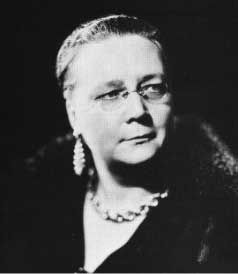
Dorothy Leigh Sayers was an English writer and scholar, born at Oxford in 1893, the only child of an Anglican clergyman. She studied medieval literature at Oxford (Somerville College), being one of the first women to graduate (1915) from that university. Her first published writings were two volumes of verse,
- 1916 Op. 1 (text at Digital
Library)
[Note: "Opus" is Latin for a work, especially an artistic production.] - 1919 Catholic Tales and Christian Songs (text at Digital Library and at CCEL)
Here (from memory) is the start of a poem from the former volume:
Christ walks the world again, his lute upon his back,
his red robe worn to tatters, his riches gone to rack.
The wind that wakes the morning blows his hair about his face,
and his arms and legs are ragged with the thorny briar's embrace,
for the hunt is up behind him, and his sword is at his side.
Christ the bonny outlaw walks the whole world wide,
singing: "Lady, lady, will you come away with me,
to lie among the bracken, and eat the barley bread?
We shall see new suns arise, in golden far-off skies,
for the son of God and woman has not where to lay his head."
She worked for several years writing advertising copy, until she was able to support herself by the sale of her books and stories.
In the following (selective) list of her works, I have made bold the ones that I think to be particularly good.
Detective Fiction
Miss Sayers's first commercially successful writings were detective fiction, and she eventually rose to the very top of that field. In Howard Haycraft's The Art of The Mystery Story, a collection of every notable essay on the detective story written before 1948, her name is mentioned more frequently than that of anyone except Sherlock Holmes. She wrote mostly about Lord Peter Wimsey, a wealthy gentleman and scholar, lover of rare books and fine wines, who solved detective cases because he enjoyed it, and was good at it, and because it was a job worth doing.
In case anyone is wondering what a writer of detective fiction is doing on a list of memorable Christian writers, I reply that a detective story can present the thoughtful reader with many observations and questions about the nature of good and evil, about difficult moral choices, and about ways of dealing with others. Detective stories, like books of any other kind, vary in quality. When you open a novel by Sayers, and find that the first words are
Thou blind man's mark, thou fool's self-chosen snare,
Fond fancy's scum, and dregs of scattered thought,
Band of all evils, cradle of causeless care,
Thou web of will, whose end is never wrought,
Desire, desire! I have too dearly bought,
With price of mangled mind, thy worthless ware.
you know that you are not reading a run-of-the-mill whodunit.
Her Wimsey books include:
- 1923 Whose Body? (audiobook at LibriVox, full text at Digital Library) In this book Sayers is in the process of creating the character of Lord Peter, and accordingly she tells us that he is witty, instead of simply recording his conversation and leaving us to think, "How witty he is!" (The reader will have noticed the same approach in A Study in Scarlet, the first of the Sherlock Holmes stories.) The story begins as a respectable architect walks into his bathroom in the morning and finds there the body of a complete stranger, naked except for a pair of pince-nez.
- 1926 Clouds of Witness (text at Many Books) Lord Peter's brother, the Duke of Denver, is tried for murder in the House of Lords.
- 1927 Unnatural Death (or The Dawson Pedigree) An elderly cancer patient dies suddenly, her death not explained by her illness. However, no means and no motive suggest themselves. Lord Peter is assisted by the elderly Miss Climpson, a devout Christian.
- 1928 The Unpleasantness at The Bellona Club A retired general is found dead in his armchair at his club. The inheritance of a considerable fortune depends on the time of his death. Lord Peter is asked to investigate.
- 1928 Lord Peter Views The Body Here we have a collection of twelve short stories. By and large, I prefer Miss Sayers's novels to her short stories, but some of the stories are good, and I know of none that I begrudge the time reading.
- 1930 Strong Poison The poet Philip Boyes is dead of arsenic. Circumstances point to the detective novelist Harriet Vane, his ex-lover, who has just rejected him, since it seems impossible that he could have ingested the arsenic anywhere but at a brief meeting with her. Lord Peter sees her at her trial, falls in love at first sight, is convinced of her innocence, finds the real murderer, and the book ends. Harriet (unlike the fair maiden whom the knight has just rescued from the jaws of the dragon) is not prepared to fall into his arms in a frenzy of love and gratitude, and their working out of their personal relationships forms the sub-plot for some subsequent books.
- 1931 Five Red Herrings (or Suspicious Characters) Lord Peter is vacationing in Scotland at Kirkcudbright, a haven for fishermen and painters. A painter, the most unpopular man in town, is found murdered, and six other painters are logical suspects. Five are red herrings (i.e. distractions or misleading possibilities), and the sixth is guilty. Kirkcudbright is a real locality (a favorite vacation spot of the author), and the story conforms to local geography.
- 1932 Have His Carcase Harriet Vane, on holiday, is walking the seacoast, takes a nap on the beach, and wakes to find herself near a corpse with its throat cut and the blood still fresh, but no murderer in sight. The plot is full of timetables and a cryptogram, as Peter and Harriet work together to find the murderer, and in the process explore their own feelings for one another.
- 1933 Hangman's Holiday Here we have another collection of short stories: four with Lord Peter Wimsey; six with another detective, Montague Egg, a traveling salesman for a company selling wines and spirits; and two other stories.
- 1933 Murder Must Advertise A copy-writer dies under curious circumstances, and Lord Peter takes his job under an assumed name in order to investigate. He is thrust into the unreal world of the drug culture, and the differently but equally unreal world of advertising, but manages to keep his head in both.
- 1934 The Nine Tailors Lord Peter's auto breaks down in the fen country
of East Anglia, and he is offered the hospitality of the local parsonage. He ends
up helping to ring in the New Year with a full peal on the 8 tower bells of the
parish church, Fenchurch St Paul's. Each bell was rung about 15000 times—nine
hours of continuous ringing! (Change ringing, an old English tradition, involves
ringing bells in a mathematical pattern. See "change ringing" in an encyclopedia.)
The year is that of the influenza epidemic, and the parish is hit hard. At the death of anyone in the parish, the lowest (tenor) bell tolls his passing. (The words "toll," "tail", and "tell" come from the same root and have related meanings, referring either to a narrative or to the numbering of something. Compare the similarly ambiguous meanings of "count", "account", "recount", "number", "score", etc.) First, nine strokes for a man or six for a woman (hence the expression "Nine tailors make a man," which is often misunderstood to mean something like "the apparel oft proclaims the man"), then N rapid strokes for the age of the dead person, and then single strokes at half-minute intervals for half an hour.
The corpse of a stranger is found hastily buried in the churchyard, and Lord Peter is asked to identify the victim, and the murderer. The background of the novel includes bellringing and parish life in the fen country of East Anglia, where the author herself spent her childhood as the daughter of a clergyman. This is one of my favorites.
- 1935 Gaudy Night The background for this novel is Oxford. Harriet Vane returns to her old college for a reunion, and finds that someone in the college is writing anonymous hate mail to various residents, and committing acts of vandalism on a minor but steadily escalating level. Harriet is asked to help identify the perpetrator. The novel reflects Sayers's love of Oxford, and her commitment to scholarship and the life of the intellect. Lord Peter joins her part way through, and their presence in a place where intellectual honesty is honored and valued helps Harriet to an honest and unflinching look at herself and at Peter.
- 1937 Busman's Honeymoon In this novel, Peter and Harriet are married, go off to spend their honeymoon in a quiet cottage, and find there the corpse of the previous occupant. The author celebrates the glory of love between husband and wife, and explores the notion of commitment to another person and what it implies. This is the last of the Peter Wimsey novels, although a few short stories follow.
- 1939 In The Teeth of The Evidence This is a collection of short stories. My
favorite is "Dilemma", which does not involve Wimsey or Egg, and is not
exactly a detective story.
That concludes the Peter Wimsey books and stories.
- 1930 The Documents in The Case (with Robert Eustace). This murder mystery is presented in the form of letters and other documents written by members of a troubled family and a few persons close to them. The novel explores personal relationships, and the question of whether the phenonomenon of life is reducible to chemical terms.
Plays
- 1936 Busman's Honeymoon (with Muriel St. Clare Byrne). This was the original form of the novel of the same name described above. It became a film starring Robert Montgomery and Constance Cummings. Co-writing it seems to have interested Miss Sayers in the challenge of writing plays.
- 1937 The Zeal of Thy House (at the Internet Archive) Canterbury Cathedral commissioned a play each year to be performed at the cathedral. (T.S.Eliot's Murder in The Cathedral, a play about the martyrdom of Thomas a Becket, had been a play in this series.) Miss Sayers wrote two plays for Canterbury. The Zeal of Thy House deals with the architect who rebuilt the central portion (the choir) of Canterbury Cathedral after the fire of 1176. The play deals with pride of workmanship, pride of possession, the creative imagination, the nature of the creative act, the doctrine of the Incarnation, and the doctrine of the Trinity. For a further discussion of the Trinity, see her book The Mind of The Maker, listed below.
- 1939 The Devil to Pay (at the Internet Archive) is Miss Sayers's second Canterbury play. It retells the story of Doctor Faustus, who sold his soul to the devil, and how God dealt with him at the last. The moral is: evil cannot be undone, but only purged and redeemed.
- 1940 He That Should Come (at the Internet Archive) This is a Nativity play, originally for radio production, although it has been adapted for the stage. While most Nativity plays take what may be called a devotional approach, Sayers gives us the story of the birth of Jesus in (except for a prologue and and epilogue) a straightforwardly naturalistic setting, in the bustle of a crowded inn, where most of those present have no idea that anything particularly significant is going on.
- 1942 The Man Born to Be King After the success of He That Should Come, the BBC invited Miss Sayers to write a series of twelve radio plays on the life of Jesus. She did so, and roused some protests from those who thought it irreverent to make Biblical characters speak ordinary (as opposed to King James) English, and in general behave like real people. She replies that her point is precisely that the Incarnation really happened—that God took human nature upon him, and lived as a real man surrounded by real people who spoke the ordinary language of their day. Each of the twelve plays is preceded by Sayers's comments, often dealing with the historical background of the incidents, and the theological issues raised by them. These are, in my judgement, outstandingly insightful and thought-provoking.
- 1946 The Just Vengeance (at the Internet Archive) This play was commissioned for the 750th anniversary of Lichfield Cathedral. It is a play about the Atonement, not in the sense of being a Passion Play, but in that it discusses the theology of the Atonement, borrowing heavily from the ideas of Dante.
- 1951 The Emperor Constantine This pageant was commissioned to celebrate the 2000'th anniversary of the city of Colchester, the presumed birthplace of Helena, the mother of the Emperor Constantine. It covers Constantine's rise to power, his conversion to Christianity, the Council of Nicea, Constantine's family troubles, and the end of his life. It deals in dramatic form with the theological issues of Nicea (whether Jesus was truly God or just a very important agent of God). As a play, with battle scenes, and council scenes, it can, if desired, be performed with "a cast of thousands", and presumably enabled anyone in Colchester who wanted to be in the pageant an opportunity to carry a spear. All in all, it is good history, and good theology, and a thoughtful discussion of the dilemmas facing a Christian in a position of power.
Non-Fiction
- 1941 The Mind of The Maker In this seminal work, Sayers discusses the psychology of the creative mind at work in producing a novel or sculpture or other work, as an aid to understanding the theological doctrine of the Trinity, and the latter as an aid to understanding the former.
- 1946 Unpopular Opinions: Twenty-One Essays Here we have provocative essays on theology, literature, and other subjects. It is now, unfortunately, out of print, but worth searching for. Many of the essays were subsequently reprinted in a collection called The Whimsical Christian (see below).
- 1971 Are Women Human? This is a small book consisting of just two essays, reprinted from the preceding work. The publisher is Eerdmans. The essays take a very different tack from that of most feminist tracts, and Sayers herself explicitly dissociates herself from "feminism," but I have known several feminists to say, "This is the work that really succeeds in saying what feminism is all about. This puts into words what I have been trying to formulate for years." Sayers begins by quoting a writer's observation that bus seats on the side next the curb are always filled first, "because men find them more comfortable on account of the slant of the roadbed, and women find that they can get a better view of the shop-windows." She notes that men are given a "human" reason for their preference, while women are given a "female" reason for theirs. She argues that every human ought to be accepted first as a person in his/her own right, with sex considered only when relevant. She does not say that it is never relevant, or that there can never be any rational disagreement about when it is relevant. She does deny the frequent assumption that when one is considering a woman it is always relevant.
- 1947 Creed or Chaos A collection of seven essays. All but the second
and sixth are also found in The Whimsical Christian, listed below. There
is considerable overlap among the essays (originally published separately).
- "The Greatest Drama Ever Staged."
- "The Triumph Of Easter."
- "The Dogma Is The Drama."
- "Creed Or Chaos."
- "Strong Meat."
- "Why Work?"
- "The Other Six Deadly Sins."
Perhaps most notable is the 1938 essay, "The Dogma is the Drama," in which she states that Christian dogma is often thought dull because people have no idea what it affirms. If they understood the teachings found in the Creeds, they might eagerly embrace them, or indignantly reject them as too far-fetched to be considered, or wistfully reject them as too good to be true, but they would not be bored. (She gives a satirical account of what the average moderately educated non-Christian thinks that the Church teaches.)
- [Added to Mr. Kiefer's essay] 1947 The Lost Tools of Learning (text at gbt.org) presented at Oxford.
- 1954 Introductory Papers on Dante The title explains the contents. I add only that they are marvelous papers, a superb exposition of Dante as poet, theologian, and lover, by a first-rate scholar who knows what she is talking about.
- 1957 Further Papers on Dante More of the same.
- 1963 The Poetry of Search and The Poetry of Statement (Gollanz). This I had not heard of until a few weeks ago (Dec 1995), when I saw a copy in a private library. I had not, alas, the opportunity to do more than glance at it. The title essay concerns poets who ask, "What is the meaning of life?" and poets who proclaim, "This is the meaning of life!" and critics who wish to exclude one class or the other from the ranks of true poets. Another essay concerns the Vision of Glory, the fading of the Vision, and the return of the Vision, as seen in Wordsworth, Dante, and other poets.
- 1987 The Whimsical Christian. This is a collection (made after her
death) of 18 of her essays, mostly reprinted from earlier collections. It was earlier
published as Christian Letters to a Post-Christian World. The present title marks
it as part of a series of books containing short selections from various Christian
authors, such as:
- "The Joyful Christian" (C.S. Lewis)
- "The Visionary Chrisian" (more C.S. Lewis)
- " The Martyred Christian" (Dietrich Bonhoeffer)
- "The Newborn Christian" (J B Phillips).
The essays in The Whimsical Christian include the following:
- "Selections from the Pantheon Papers." A parody written for PUNCH.
- "The Greatest Drama Ever Staged." On the Incarnation.
- "Strong Meat."
- "The Dogma is the Drama." Most non-Christians, and most Christians, do not realize how exciting the official Christian creed really is.
- "What Do We Believe?"
- "Creed or Chaos?"
- "A Vote of Thanks to Cyrus." Sayers remembers realizing as a child that the Cyrus mentioned in the Bible is the same Cyrus found in her history books, and that the Bible is about things that actually happened in this world, not a tale off in some other dimension. (Along the same lines, a teacher in the New York schools reports the electric effect on his students when he was telling them how the early American settlers sailed across the Atlantic, and then pointed out to them that the Atlantic was the same body of salt water that they could see from the harbor a short distance away. It had never occurred to most of them that there was any connection between their history books and reality.)
- "The Dates in The Red-Headed League." This is one of many essays, in a tradition begun by Ronald Knox, analyzing the Sherlock Holmes stories using the techniques applied by many scholars to the analysis of the Scriptures.
- "Toward a Christian Esthetic."
- "Creative Mind."
- "The Image of God."
- "Problem Picture."
- "Christian Morality."
- "The Other Six Deadly Sins." The traditional list of Seven Capital Sins, reading from most serious to least serious, is: Pride, Envy, Anger, Sloth, Avarice, Gluttony, and Lust. However, many persons have gotten the impression that the Church is concerned only with the last of these. Sayers undertakes to remind her readers of the other six.
- "Dante and Charles Williams." Charles Williams, poet, novelist, critic, historian, theologian, and mystic of the Affirmative Way, first got Sayers interested in Dante. She here writes about Williams's interpretation of Dante.
- "The Writing and Reading of Allegory."
- "Oedipus Simplex: Freedom and Fate in Folklore and Fiction."
- "The Faust Legend and the Idea of the Devil."
Translations
- 1929 Tristan in Brittany, from Old French.
- 1957 The Song of Roland, from Old French. This is the story of Charlemagne's invasion of Spain and his battles against the Saracens, and in particular of how his elite guard, headed by his nephew Roland, was killed in battle as the result of treachery, and how Charlemagne avenged their deaths. It is an epic poem about the struggle between Christians and their pagan enemies. It is historically inaccurate, and inaccurate in its portrayal of Islamic theology (errors by the original medieval poet, not by Sayers), but sound in its treatment of Christian issues.
- 1949, 1957, 1962 The (Divine) Comedy of Dante Alighieri. This translation from the Italian of one of the world's greatest works of literature and of theology is far and away my favorite English version of Dante. Even those who prefer another translation (or who read the poem in Italian) will find the notes invaluable. For details, see the biographical sketch of Dante, listed at 15 September.
Dorothy L. Sayers died 17 December 1957, leaving her translation of the Comedy unfinished. The last thirteen cantos and the notes and commentary to the Paradiso were supplied by her friend and fellow Dante scholar, Dr. Barbara Reynolds.
Books about Dorothy L. Sayers include the following:
- A Bibliography of The Works of Dorothy L. Sayers, by Colleen B. Gilbert (MacMillan, NY, 1978).
- An Annotated Guide to The Works of Dorothy L. Sayers, by Robert B. Harmon and Margaret A Burger (Garland Publishing, NY, 1977).
- Dorothy L. Sayers: The Life of a Courageous Woman, by James Brabazon (Gollanz, 1981). The first "authorized" biography, with the co-operation of her literary heirs and her publisher.
- Maker and Craftsman: The Story of Dorothy L. Sayers, by Alzina Stone Dale (Harold Shaw Publishers, Wheaton, 1992, ISBN 0-87788-523-0). Has two-page bibliography, with a list of DLS's works and a selected list of works about her.
- Dorothy L. Sayers: The Centenary Celebration (Walker & Co, New York, 1993, ISBN 0-8027-3224-0), ed. Alzina Stone Dale. This is a collection of essays by various writers about various aspects of the work of DLS, prepared for the centennial of her birth.
- Dorothy L. Sayers, Spiritual Writings, selected by Ann Loades (Cowley Publications, Boston, 1993, ISBN 1-56101-066-9, a set of extracts from the writings of DLS.
- Dorothy L. Sayers, Her Life and Soul: A Biography, by Barbara Reynolds (Hodder and Stoughton, London; St Martin's Press, New York, 1993, ISBN 0-312-09787-5). The author is a Dante scholar who supplied the last 13 cantos for the translation of Dante's Comedy which DLS left unfinished at her death. She had known DLS for many years and discussed her work and her ideas with her in depth.
- The Passionate Intellect: Dorothy L. Sayers's Encounter With Dante, by Barbara Reynolds (Kent State U Pr, 1989). See the preceding entry.
- The Remarkable Case of Dorothy L. Sayers, by Catherine Kenney (Kent State U Pr, Kent (Ohio) and London, 1990, ISBN 0-87338-410-5 (hb) and 0-87338-458-X (pb)) This work offers a careful analysis of Sayer's writings and ideas.
written by James Kiefer
Prayer Almighty God, who gave to your servant Dorothy L Sayers special gifts of grace to understand and teach the truth as it is in Christ Jesus: Grant that by this teaching we may know you, the one true God, and Jesus Christ whom you have sent; who lives and reigns with you and the Holy Spirit, one God, for ever and ever. Amen.