Seleccionar idioma español/Choisissez la langue français
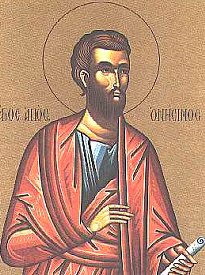
From Paul's letter to Philemon, we learn of four Christians from the city of Colossae:
- Philemon and Apphia (assumed to be his wife)
- Archippus
- Onesimus, a runaway slave of Philemon's
I invite you to read Paul's letter with me (the translation is that of J. B. Phillips).
The background of the letter seems straightforward. Philemon was a prosperous Christian, a member of the church in Colossae, and probably personally known to Paul, and converted by hearing him preach. He had a slave named Onesimus (the name means useful, a fact referred to in the letter), and perhaps Onesimus knew Paul also, at least by sight. After Paul had left Colossae, and was in prison (probably at Rome (in Italian, in English), Onesimus ran away, taking some of his master's money, and eventually arrived in Rome, where he met Paul, and became a Christian. Paul sent him back to his master (other considerations aside, the Roman government was very efficient about catching and returning runaway slaves), but with a covering letter.
As you read the letter, stay loose. It is by all odds the funniest chapter in the New Testament. Note how Paul says, "Of course I wouldn't twist your arm or anything!" to the accompaniment of splintering bone.
Paul, prisoner for the sake of Jesus Christ, and brother Timothy to Philemon our fellow worker, Apphia our sister and Archippus who is with us in the fight; to the Church that meets in your house -- grace and peace be to you from God our Father and from the Lord Jesus Christ.
I always thank God for you, Philemon, in my constant prayers for you all, for I have heard how you love and trust both the Lord Jesus Himself and those who believe in Him. And I pray that those who share your faith may also share your knowledge of all the good things that believing in Christ can mean to us. It is your love that gives us such comfort and happiness, for it cheers the hearts of your fellow-Christians. And although I could rely on my authority in Christ and dare to Order you to do what I consider right, I am not doing that. No, I am appealing to that love of yours, a simple personal appeal from Paul the old man, in prison for Jesus Christ's sake. I am appealing for my child. Yes, I have become a father though I am under lock and key, and the child's name is -- Onesimus! Oh I know you have found him pretty useless in the past, but he is going to be useful now, to both of us. I am sending him back to you: Will You Receive Him As My Son, Part of Me? I should have dearly loved to have kept him with me: he could have done what you would have done -- looked after me here in prison for the Gospel's sake. But I would do nothing without consulting you first, for if you have a favor to give me, let it be spontaneous and not forced from you by circumstances.
It occurs to me that there has been a purpose in your losing him. You lost him, a slave, for a time; now you are having him back for good, not merely a slave, but a brother-Christian. He is already especially loved by me -- how much more will you be able to love him, both as a man and as a fellow-Christian! You and I have so much in common, haven't we? Then do welcome him as you would welcome me. If you feel he has wronged you or cheated you, put it down to my account. I've written this with my own hand: I, Paul, hereby promise to repay you. (Of course, I'm not stressing the fact that you might be said to owe me your very soul!) Now do grant me this favor, my brother -- such an act of love will do my old heart good. As I send you this letter I know that you'll do what I ask -- I believe, in fact, you'll do more.
Will you do something else? Get the guest-room ready for Me, for I have great hopes that through your prayers I myself will be returned to you as well!
Epaphras, here in prison with me, sends his greetings: so do Mark, Aristarchus, Demas, and Luke, all fellow-workers for God. The grace of our Lord Jesus Christ be with your spirit. Amen.
Paul
A friend of mine read this, laughing, and then said, "If anyone sent me a letter like that, I would be really steaming!" And indeed, one of the first things a reader notices about this letter is the way Paul completely boxes the poor guy in. The final touch is Paul's suggestion that he may soon be released from prison and making an appearance in Colossae. If Philemon had any thought of selling Onesimus to work in the lead mines, he was confronted with the prospect of Paul's arrival any day on his doorstep, with a cheerful, "Greetings, Philemon, and where is our dear brother Onesimus?" On the other hand, one has to remember that Paul was writing with a very worried Onesimus looking over his shoulder, an Onesimus whom he had talked into going back, and to whom he had promised a letter positively guaranteed to get him off the hook where his master was concerned. Onesimus was probably saying, "Make it stronger! Make it stronger!"
A point that will trouble many a modern reader is that the letter says nothing (nor does the rest of the Bible) about the injustice of slavery. We should like Paul to deliver a ringing manifesto, bluntly telling Philemon that no man has the right to own another man, and that it is his duty to free all his slaves, and to boycott all goods produced with slave labor, and to tell all his friends to do likewise. That this approach would have been less likely to help Onesimus does not bother us—we are quite prepared to sacrifice Onesimus for the principle of the thing. But Paul knows that there is in his day no shortage of philosophers teaching that slavery is unjust and contrary to the Law of Nature. He takes a different approach. He simply says, "Onesimus is your brother in Christ. What does that suggest about what you ought to do with him?"
Philemon has doubtless grown up taking slavery for granted. When Onesimus runs away, taking with him some of Philemon's money, Philemon considers himself the injured party. And Paul does not question that assumption. When he mentions the money that Onesimus has stolen, he does not urge Philemon to balance it against the fact that he has robbed Onesimus of his freedom, has gotten many hours of unpaid (save for maintainance) labor from him, and, when the sums are totaled on both sides, will probably turn out to owe Onesimus far more than Onesimus owes him. Instead, he simply says, "Put it down to my account. Charge it off against what you owe me."
And Paul's credit balance with Philemon, as they both knew, was considerable. The most important thing in Philemon's life, the thing that made that life worth living, was his knowledge of the Good News of God in Christ Jesus; and this he owed to Paul, who had brought it to him and others at a considerable cost to himself—"with labors, with imprisonments, with beatings, with near approaches to death. Five times I have received at the hands of the Jews the forty lashes less one. Three times I have been beaten with rods; once I was stoned. Three times I have been shipwrecked; a night and a day I have been adrift at sea; on frequent journeys, in danger from rivers, danger from robbers, danger from my own people, danger from the Gentiles, danger in the city, danger in the wilderness, danger at sea, danger from false brothers, in toil and hardship, through many a sleepless night, in hunger and thirst, often without food, in cold and exposure." (2 Corinthians 11:23-27) Paul may be blowing his own horn, but we have no reason to suppose that he is exaggerating. Philemon's debt to Paul (and ours, for that matter) is incalculable.
Here in this letter we are shown the Christian doctrine of forgiveness in action (Practical Christian Life). As Christians, we are to forgive those who have injured us, to be prepared to be reconciled with our enemies. In our quarrels with others, we often suppose ourselves to be mostly or entirely in the right (as we may guess that Philemon did in his quarrel with Onesimus). It is possible that God, or even a impartial human observer, might evaluate the matter differently. But never mind that. Let it be granted, for the sake of argument, that we are entirely the injured party, and that our opponent is without mitigation or excuse. Paul says to us, as he did to Philemon, not, "Your opponent does not owe you as much as you think he does," but rather, "Whatever he owes you, put it down to my account."
This would be impressive enough if it were only Paul who said it. But in fact he is passing on to us, both in word and deed, that which he has received from his Master. Paul was moved to undertake a life of danger and hardship, spreading the Good News about Christ, was moved to give his whole life to Christ, because he knew that Christ had given His life for Paul. And Paul's words to Philemon are simply an echo of Christ's words to each of us. "If your brother has injured you, if you feel that he owes you anything, put it down to My account—charge it off against what you owe Me." And Christ in His turn has earned the right to say that to us, because He once stood before Pontius Pilate and, being accused, made no reply in His own defence, choosing rather to say, "Whatever wrong anyone has committed, whatever debt or penalty incurred, put it down to My account."
"Forgive our sins as we forgive,"
You taught us, Lord, to pray;
But You alone can grant us grace
To live the words we say.
How can Your pardon reach and bless
The unforgiving heart
That broods on wrongs and will not let
Old bitterness depart?
In blazing light your cross reveals
The truth we dimly knew:
How trifling others' debts to us;
How great our debt to You!
Lord, cleanse the depths within our souls
And bid resentment cease;
Then, by your mercy reconciled,
Our lives will spread your peace.
Rosamond E. Herklots (1905-1987) copyright Oxford U Press
written by James Kiefer